Tuesday, April 25, 2017

Sample Poetry Blog Post 2

Question:
There are many strategies by which poets increase the effect of their words and one of those is the repetition of words, images, sounds and the like. In the work of ONE poet you have studied, show how various kinds of repetition have allowed poets to heighten their meaning.

In the poem, “‘Hope’ Is The Thing With Feathers”, Emily Dickinson relies on the repetition of of words, sounds, and feelings to heighten the feeling of her writing. While the poem focuses on the characteristics and what defines the feeling of hope, there are many stylistic features used - instead of just the meaning of each sentence - to evoke emotion from the reader.
One of the most obvious and smart stylistic features Emily Dickinson relies on to heighten the meaning of her poem is emphasizing the specific sound the letter S makes. Using words such as “sings”, “stops”, “sweetest”, “sore”, “so”,“asked”, “chillest” and “strangest”, Emily Dickinson creates a feeling of constant movement in this poem. Not only does this repetition of sound allow the stanzas of her work to flow well, it adds to the freeing emotion of liberation she has created by comparing hope to a bird, which is able to fly. This constant use of the same sound from the letter S, allows her words to feel as if they are flying when read allowed or when read in the reader's mind, just like the image and feeling she is creating by using a metaphor of a bird and/or flying for the feeling of hope. In addition to repeating the sound, it allows the poem to repeat the feeling of what hope exactly brings to a person,  a desire or expectation for something to happen. While not every word previously listed may sound exactly alike, they each contain a light, specific S sound, creating a feeling of movement in her stanzas.
In addition to this repeated sound, Emily Dickinson uses the word “And” multiple times throughout the poem at the start of various sentences. This, in addition to the repeated S sounds allows the reader to feel as if the poem is constantly growing, and there is height in the feeling of hope. Using the specific word “And” allows the reader to think that hope can persevere through challenges, and this combined with the soaring feeling the S sound makes, forces the poem to become very powerful.
However, Emily Dickinson is able to make her poem feel as if it has an abrupt ending by breaking this form of repetition. By using the  two words, “abash” and “Extremity”, Emily Dickinson disrupts this soaring feeling, and as a result, creates a new, crashing like feeling with her language. This break in pattern causes an unusual, foreign feeling, which goes against what Emily Dickinson had previously created throughout the entirety of the poem. As a result, it creates a change in tone and feeling, which goes along perfectly with the change of attitude the narrator has at the end of the poem. While before the poem repeatedly generated the feeling of hope, the change in speech, meaning of the lines, and tone disrupts all previous growth of hope, and like the language, a crash in feeling occurs.   
Emily Dickinson’s repetition of words, sounds, and feelings in “‘Hope’ Is The Thing With Feathers” allows the poem to grow, and gradually gain powerful emotion. While the overall meaning of this poem is powerful enough, it is her literary and stylistic features that take the poem to the next level, making it an overwhelmingly strong piece of writing.  

Thursday, April 20, 2017

Sample Poetry Responce

1. Ancestors, parents, children. The connections and oppositions among these groups often provide interesting material for poets. In the work of at least two poets you have studied, examine the means by which such relationships have been explored.


In Naomi Shihab Nye’s “My Father and The Fig Tree”, a clear relationship is shown between the speaker, and their father. As the poem begins, the reader becomes immediately aware that our speaker, now older, is looking back on his/her childhood and the relationship they had with their father. In addition, the reader can understand how well the speaker knows their father, as they observe his obsession and fascination with figs, a fruit he adores. From the very beginning of the story, the speaker addresses this, by showing his love for the fruit in everything he would do- whether it was including the fruit in his stories or even being overjoyed when he finds a fig tree in Dallas, Texas- his love for them is clearly shown.
In the first stanza, it is evident that the speaker and the father shared a close relationship, as they say: “In the evening he sat by my bed weaving folktales like vivid little scarves.” Because storytelling is an intimate craft/art form, the speaker is portraying the time they spent one on one with their father. The speaker even goes as far to portray their father as an artist, as they romanticize his actions by using metaphors and similes.
However, in the second stanza, there is a clear shift in their relationship. When the speaker addresses the first time they ate “a dried fig and shrugged”, there was a divide between them and their father. The speaker goes on to say that their father wanted them to eat a fresh fig rather than a dried one, as a way to fully experience the fruit/.; However it is not just the taste of the fruit the father is trying to make his child understand, rather, he uses the fig as a symbol of his home country, and by eating a fig (a fruit that grew there and not where he is currently living) it reminds him of his homeland.
This is not to say that eating the dried fig divided the relationship between the father and his child completely; it didn’t.  In the last stanza, we can see they still have a connection with each other when the father calls the daughter after moving to let her know he found a fig tree growing in his new backyard. When he shows her the new fig tree, it symbolizes that this new home is their home. In addition, we can assume that he was able to give his child a ripe fig to try, symbolizing the child is able to understand and have a deeper connection to him and to his past home.  

Monday, April 17, 2017

Stage Proposal of M.L.M.L.

If I were to adapt “My Love, My Love or the Little Peasant Girl”, I would rely heavily on sounds, projections, costumes, and props to bring it to life. I would hope to use a large stage, where many levels could used- The Gods would be placed on a higher level, while the peasants and wealthy citizens belong on the actual stage. In order to show the different settings, I would rely on projections to set the background. For example, in specific rooms such as the forest (for the river scene) or Daniel’s room (when Ti Moune begins to spend time with him), I would use large projections that would cover the entire backdrop to look as if we were in those settings. Then, I would place appropriate props, such as chairs, beds, rugs, etc. to bring the set to life.

When the play takes place in the “peasant” setting (Desiree’s village) I would project fields in the background to show the climate and environment that they live in. I would fill the stage with extra actors, all wearing bleak, earth tone colors, to make it look busy and to show their socio-economic class. However, in scenes where Desiree is in the Beauxhommes home, I would have a projection of an extravagant room, with bright colors as the backdrop. Then, to make it more lavish, I would fill the stage with classical furniture, to give it an old, wealthy feeling and dress those who belong in the wealthy class in extravagant blues and whites. These are traditional royal colors of France, and because the wealthy class is French, these colors will show their heritage and wealth when contrasted with the poorer class. .

In addition to using props and projections for the set, I would use a projection of a butterfly whenever they are in the scene. That way they would be able to move around the set, and the audience would be able to spot them out. As far as colors go, I would only have the butterflies be blue because that is the color of the dress that Desiree wears when she first goes into the home of the Beauxhommes.

However, I would refrain from using certain colors in hopes to  make other objects stand out. For example, I would not use the color red for any props or costumes other than that of Papa Ge’s and the magical hairbrush Erzulie gives to Desiree. By doing this, the object and God will be recognizable and stand out amongst the scenery.

I would dress all the gods in specific colors: Erzulie in creams and oranges, Asaka in browns, greens, and golds, Agwe in blues, turquoise, and silver, and Papa Ge in electric red, black and greys. I would want their clothes to be loose on them and flowing, with the exception of Papa Ge. While he is still a god, and of equal level as Asaka, Erzulie, and Agwe, I want to portray him as an outcast (or at least that he doesn’t perfectly fit in with them). This can highlight conflict between him and the other gods, as they are constantly trying to help Desiree, while he spends his time attempting to take her soul.

While there are many ways in which I could adapt “My Love, My Love”, I would focus on these elements to give it a dark-fairytale type feeling. Using projections, a vast array of costumes and sounds would allow it to feel whimsical and unique, which the novel already is.

Friday, April 14, 2017

In Class Writing (Close Reading on Page 60)

In this passage, there is a big conflict between M. Bienconnu and Desiree. Both have different belifes about what Desiree’s future is, and it can be clearly seen in the language. For example, M. Bienconnu uses a strong metaphor when talking to Ti Moune about setting realistic expectations for herself: “To be tranquil, one must hang one’s hat where one can reach it. Keep one’s heart where one can feel its beat.” (60)  M. Bienconnu uses this strong metaphor in hopes to make Desiree understand that Daniel is out of her league due to his social class. When she goes on to question this, he uses another metaphor, saying that fate is cast in stone. In a literal sense, when something is engraved in stone, it is unable to be changed. So, when he says that fate is the thing cast into stone, he is saying that there is no way in which she will be able to be with Daniel. This language also allows the reader to get a sense of who his character is, his tone is calm (mostly achieved by the use of his metaphors) and because of his straightforward and honest conversation, it can be assumed that he is very wise. However, Ti Moune contrasts him due to her sharp, to-the-point, stubborn replies shows her youth, as she has not experienced any harsh reality- thus showing that she lives mostly in day dreams. She constantly sticks to her beliefs that she and Daniel will end up together, whereas M. Bienconnu is more realistic.

Thursday, April 13, 2017

In Class Writing

In order to show the difference between Desiree and the peasants, their costumes would have to be very different. For the peasants, I would dress them in mostly earth-tone colors, such as browns, blacks, and greys. This would show their financial situation, as they would be unable to afford colors. I would have the men wear loose shirts with loose pants (to indicate that they live in a warm climate and move around alot). For Ti Moune, I would have her wear a short, dark, burnt orange color. I would want it to fall to her mid-thigh, have short, shoulder-length sleeves, and be only a little loose. This would help the audience notice that she is stuck in a childlike dress after she physically matures. In addition, I would have the female peasants wear their hair up, whereas with Desiree, I would have her wear her hair down and out of her face with a loose bandana, so that the audience could fully see her face and expressions. Perhaps the most important similarity between Desiree and the other peasants would be their bare feet. That way, the audience can tell even more that they belong in the same social class as opposed to the wealthy citizens who actually wear shoes. In addition, I would have all peasants and Ti Moune not wear jewelry, so that it could be inferred that they can’t afford it.    

Thursday, March 30, 2017

Oral Reflection

When I was preparing for my Oral Commentary, I wasn’t very nervous. I had just completed a similar assignment for my English class, so I felt as if I knew exactly what I was preparing for. I had also reflected many times on my scene, my performance, and thought thoroughly about why we did what we did on stage, so when I was doing the commentary, I pretty much knew what I was going to say, and knew where I was going to go when speaking. I am pretty pleased with my Oral, I thought I covered every base and spoke at a good tempo. I am very appreciative that I was able to get an opportunity to practice, however, because Mrs. Guarino gave me great notes on various topics that I missed. Because of this, my actual Oral went very smoothly, and I felt confident when it had finished.

To be honest, my favorite part of the oral was explaining what I do differently and why.  When I was talking out things I could change, I became inspired, and I was able to visualize my scene with different props, costumes, etc. and how it would affect the overall performance. I hope that the IB will like my oral, and although I stated that I felt confident with the finished product, I hope they understand the various topics I touched upon. If I had to do the oral again, I would limit my use of “um”s, and phrase my sentences in a more coherent way. Often I would start a sentence, and think a new thought during it, stop the sentence, say the new thought, and return to the old sentence. It can be a little confusing when listening to it, and despite the fact that I knew what I was talking about, I hope the IB does as well.

Monday, March 27, 2017

Written Oral: Rough Draft

The short story “Nineteen-Thirty Seven”, focuses heavily on the impact of religion and/or belief on relationships. Because this story showed so much potential for different contemporary forms of adaptation, I was very interested in picking it for my scene. I loved the idea of working in a small group of all women and the many different ways the scene could be altered to show their connections with one another.
 Therefore, I aimed to highlight the role faith played in each relationship between the Madonna, the mother, the grandmother, and Josephine, while also demonstrating the impact it had in their decision making.  By showing each of their feelings throughout the scene, the audience was able to gain an insight as to how religion affected their relationships with each other, and how it influenced the decisions they made.
In the actual short story, the Madonna is a figurine that Josephine's mother latches onto for emotional comfort and spiritual guidance. However, in our scene, we chose to have the Madonna begin the scene as a doll, and once Josephine loses her mother, she comes to life. By adapting this aspect of the story, we were able to allow the Madonna to actually guide the mother (and eventually Josephine) throughout her life. It gave the scene and the audience a new perspective, showing the mother constantly consult the Madonna as her guide and her crutch for support.
In order to portray my character, the Madonna, as a god-like figure whose sole purpose was to help the mother, I knew I would have to have a strong presence on stage. In order to achieve this, I manipulated by body language and my vocal tenacity. For example, whenever walking around on stage, I tried to stand as straight as I could, holding my head up. However, when I needed to show that I was a form of comfort for the mother, I would lower myself to be on her level, make eye contact, and establish a sense of touch whenever speaking to her. When I did verbally communicate with her, I tried to speak slowly and calmly, only using louder volume when a situation called for it. For example, when the Madonna chases after the mother in the river, I used louder volume to show the audience that I was gaining her attention, and to demonstrate that I was powerful.  Therefore, I was able to show that while I was still on a higher social level than her, I could still emotionally connect and have sympathy for her.
While all of this worked very well for the scene, I would do a few things differently. Specifically, I would limit the overall number of scene changes and use different props. Because of the constant stopping to change scenery or to transition, our scene was unable to flow. If I were to correct this, I would rewrite the script and comprise scenes so that hopefully it would not only flow more, but also so that the audience would be able to focus more on the relationships, plot, and characters. If I had the opportunity to change some of the props, I would love to use an actual Madonna figure. This way, the audience could understand that the Madonna is a symbol for religion. Because we used a cluster of fabric for this, I fear our audience will lack this understanding.

Thursday, March 9, 2017

Reflection


Looking back on our performance, my favorite part of the performance for me was out lighting. I was so happy with every perfectly timed black out, fade out, special effect lights, etc. When writing the script, I had a clear vision as to what I wanted with he lights, and I am so thankful that we were able to achieve it. Each lighting effect was planned and carefully executed, and it really looked professional. Especially during the river scene. The blue accents on the hanging fabric on the triangle brought the scene to life, and I believe made it more visually interesting for the audience. I believe the most important part of our story that we adapted was the river, and how it acts as a turning point for the mother’s journey in her life. Therefore, I think it was perfect how the river scene in our performance naturally became the most abstract, intriguing, and visually satisfying moment and stage layout. By far and away, this was my favorite part of the performance. We were able to use the triangles to our advantage, by hiding things behind them, running around them as if Sam was wading in the water, and as an abstract aspect.

What I would change about the performance if I redid it would be the many scene changes. By the time my group was given this note and realized how it interrupted the flow of the scene and made it confusing for the audience, it was unfortunately, a little too late to undo. Looking back, I do see the scene changes as a problem, and I know if we were able to limit them, my partners and I would have less of an issue making the scenes flow and would be able to focus more on the actual scenes, than having to worry about their many, different set ups. However, I do think the many different changes were necessary with the script that we wrote and re-wrote, so the only way we would be able to realistically improve this, would have to be through re-writing the entirety of the script again. Im sure if I was to watch the video I would want to change more, however this seems to be the most evident place for improvement.

Overall, I really feel as though my scene partners and I pulled our project together very well. It took so much work in a very limited time frame, however I am so pleased with how the final version turned out. This process has been challenging, yet extremely  interesting, and I am glad I was fortunate enough to take part in it. Every scene from our class, not just ours, was above and beyond, and I am so proud of our IB Literature and Performance Class.
I am so honored to have been a part of such a wonderful group of actors, and I have loved working alongside Nadya and Samantha. We really tried our best to make this scene as great as we could, and I know our hard work has paid off.

(Video of Rough Draft Is Published On Separate Blog Post)

Thursday, February 9, 2017

Script, sound and lighting cues, props, and Stage Layout with Description. See other post for Costumes.

Madonna - Abby
Mom - Sam
Josephine - Nadya


Beginning
  • Massacre
  • Escape
Middle
  • Visit to river
  • Teaching the call and-response
End
  • Dead baby
  • Police
  • End with madonna and child repeating game again?


Props:
  • Blue fabric to cover triangles
  • House set
  • Bed
  • Couch
  • Desk
  • Table
  • Four Chairs
  • Wings of fire
  • Rock
  • Fauna near river


Sounds:
  • Gunshots
  • Screaming


BEGINNING
Add lights here
Grandma: Did you hear what Trujillo said the other day? He will not stop at anything to insult Haitians.
Mom: I know. Edwidge’s family has already left. Their youngest is only four months old. They don’t want their children to grow up here.
Grandma: It may be our time soon as well.
Mom: In this state, I can’t go anywhere.  
Grandma: Let us pray. Bondye will watch over us.
(multiple gunshots, screams heard outside. Chaos and panic ensues in the room.)
Women shouting, screaming “What is going on?” “Run!!”
(gunshots getting louder and louder)
(ladies shuffle quickly offstage)
Gunshots/screams can still be heard during scene change?


House? (gunshots can be heard in background)
Mom: (clearly stressed, frazzled) (talking to herself) What to bring? What to bring? (picks up a shirt) No, we don’t need this.
Madonna: We don’t have time for this. We must go. A single change of clothes, if anything.
Mom: I know, I know. But my child. My time is coming and we will have nothing.
Madonna: You will have me. It will have to be enough.


At edge of river (one side of stage) (gunshots can be heard, but faint)
Madonna: Come, faster. I see them over that hill. Faster
Mom: (clearly distressed) I cannot. I feel my child moving and kicking. I'm scared; please, Let me sit.
(sits on nearby rock?)
Madonna: You must go on, for the child. We both know it will be safe on the other side. Take the child away from all this violence.
Mom: I know. It’s hard. (takes a deep breath. Talking to Josephine) It’s going to be okay. We will get through this. (looking up to Madonna) We all will.
Madonna: (gently lifting Mom up) Come, we must go.
(Madonna helps the mother find her way through the rest of the river. The mothers exists the rivers wearing red for wings)  
Lights focus on Mother, preferably red lighting. Then, it slowly fades off.


MIDDLE
Lights Up Full Stage (white)
J: Tell me the story again.
Mom: Again? Josephine, this story gives you nightmares.
J: Please?
Mom: Alright. It was 1937, 12 years ago. The Madonna and I were at home with some friends when we heard shouting down the street. The soldiers had come for us Haitians. We knew we had to leave quickly. The back door was our only way out. We ran and ran, until we got to the river that divides this island. With nowhere else to go, we jumped in. But Josephine, that water changed us. We emerged new women, soaked in the red of the blood-tainted river. The soldiers ran, for we had wings of fire. I lost my mother that day, Josephine. But I got you.
J: What about the others?
Madonna: (Interrupts) You will meet them soon enough. Go to bed, Josephine.
Lights go down on the bed, and go up center stage
Mom: Why can’t I tell her about us?
Madonna: Because she is not ready. She will learn about the others in time.


(sees Madonna getting Josephine ready to leave)
Mom: Where we taking her now?
Madonna: The river. The others are meeting there today. She is ready to meet them.
Mom: Hopefully there won’t be too many. The police are already on high alert from the festivities.
Madonna: Don’t worry.
Lights Fade
(exit stage right)


Lights Up Full Stage(white)
Madonna: It’s time to teach her what your mother taught you.
Mom: No. She’s too young.
Madonna: And you’re too old.
(Mom sits down, thinking. Sees Josephine playing stage left)
Madonna: (puts hand on Mother’s shoulder) It’s time.
Mother: (takes a deep breath) Josephine love, come here. I want to teach you something.
All light fades, except a soft circle light that focuses on the pair
Mom: Who are you?
J:I’m a child of that place. I come down from that long trail of blood.
Full Lights fill the stage again
Mom:Where are you going?
J:I am walking into the dawn.
Mom:Who are you?
J:I am the first daughter of the first star.
Mom:Where do you drink when you're thirsty?
J:I drink the tears from the madonna's eyes.
Mom:And if not there?
J:I drink the dew.
Mom:And if you can't find the dew?
J:I drink from the rain before it falls.
Mom:And if you can't drink there?
J:I drink from the turtles hide.
Mom:How did you find your way to me?
J:By the light of the mermaid’s comb.
Mom:Where does your mother come from?
J:Thunderbolts, lighting, and all things that soar.
Mom:Who are you?
J:I come from the puddle of that river.
Mom: Speak to me.
J:You hear my mother who speaks through me. She’s the shadow that follows my shadow. The flame at the tip of my candle. The ripple in the stream where I wash my face. Yes. I will eat my tongue if I ever whisper that name, the name of that place across the river, that took my mother from me.


Our mothers were the ashes and we were  the light.  our mothers were the Embers and we were the sparks. our mothers were the flames and we were the blaze.
“Here is my child, Josephine. We were saved from the tomb of this river when she was still in my womb. You spared us both, her and me, from this river where I lost my mother.”


END
(Josephine and her mother are onstage. The Madonna is nowhere to be seen)
Mom: Josephine, what do you know about the Madonna?
J: I know she has been with you since you crossed Massacre River. She saved our lives.
Mom: You’re right. We do owe our lives to her.
J: Why do you ask, Manman?
Mom: Josephine, I am getting older. I am afraid our time together might be running out.
J: I’m not ready to say goodbye, Manman.
Mom: I know, Josephine. Neither am I. But while we still have time together, remember that I want you to keep the Madonna when I am gone. When I am completely gone, maybe you will have someone to take my place. Maybe you will have a person. Maybe you will have some flesh to console you. But if you don’t, you will always have the Madonna.
Full Lights fade back up
(Guards take mother away, mother throws wings back to Josephine, Josephine reaches for jacket) Mid reach, the lights immediately blackout.
Spotlight comes back on on Josephine & Madonna onstage back to audience, says ending to response, blackout
Blackout remains
J: “I am the child, Josephine. My mother was saved from the tomb of this river when I was still in the womb. You spared her from this river where she lost her mother. Our mothers were the ashes and we were  the light.  our mothers were the Embers and we were the sparks. our mothers were the flames and we were the blaze.”


RANDOM LINES TO INCORPORATE
“Let her flight be joyful, and mine and yours too.”


STAGE LAYOUT AND DESCRIPTION

Escaping through Massacre River
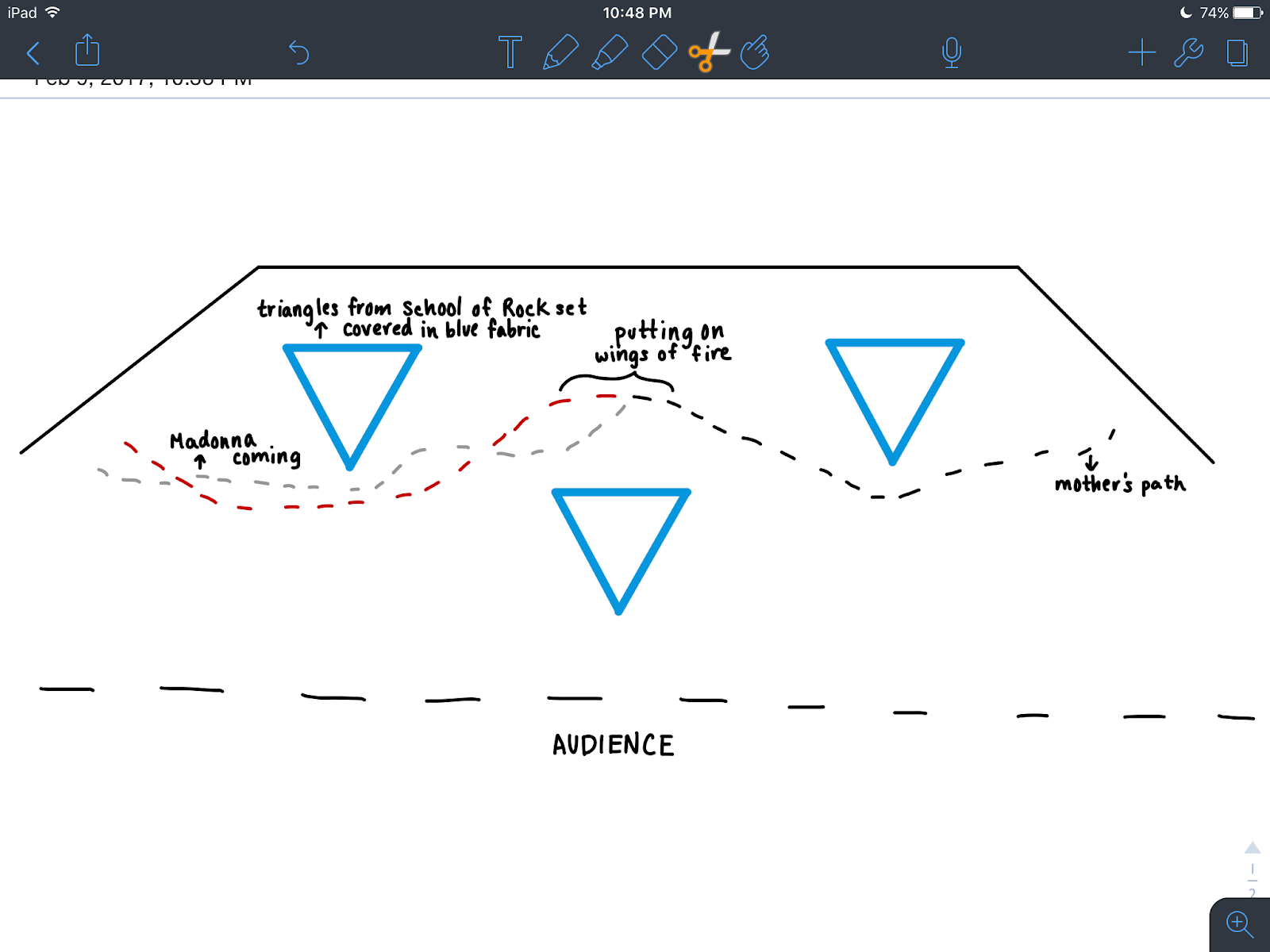
For the very opening scene, we will take 3 triangles from School of Rock and cover them in blue fabric, to look like a river. They will be staggered across the stage, providing cover for the mom to put on “wings of fire” (just a costume piece) and emerge from the blood stained water. To show the blood from the massacre, we may add red fabric to the triangles.
The Home

The majority of the skit will take place in the home of the three girls. There are 3 “sections” to the house: a bedroom, a dining area, and a play area. To the left is the bedroom. This is where personal conversations between the Madonna and the mother take place. Stage right is the play area, where the Madonna interacts with Josephine. In the middle, the mother and daughter meet. The play area has a couch and some toys - worn, cloth dolls. The dining room is just a wooden table and chairs. We will use colorful blankets and set pieces to make each section look more abstract and bring attention to the “fire” aspect of the skit.
The River
A few times in the skit, the mother brings Josephine to massacre river to pray. The set for this will be very simple, bringing back the blue fabric to show the river. This time, there is no blood.

Thursday, February 2, 2017

Progress of Script

Madonna - Abby
Mom - Sam
Daughter - Nadya

Beginning
  • Massacre
  • Escape
Middle
  • Visit to river
  • Teaching the call and-response
End
  • Dead baby
  • Police
  • End with madonna and child repeating game again?

Madonna: It’s time to teach her what your mother taught you.
Mom: No. She’s too young.
Madonna: And you’re too old.
Who are you?
I’m a child of that place. I come down from that long trail of blood.
Where are you going?
I am walking into the dawn.
Who are you?
I am the first daughter of the first star.
Where do you drink when you're thirsty?
I drink the tears from the madonna's eyes.
And if not there?
I drink the dew.
And if you can't find the dew?
I drink from the rain before it falls.
And if you can't drink there?
I drink from the turtles hide.
How did you find your way to me?
By the light of the mermaid’s comb.
Where does your mother come from?
Thunderbolts, lighting, and all things that soar.
Who are you?
I come from the puddle of that river.
Speak to me.

You hear my mother who speaks through me. She’s the shadow that follows my shadow. The flame at the tip of my candle. The ripple in the stream where I wash my face. Yes. I will eat my tongue if I ever whisper that name, the name of that place across the river, that took my mother from me.